
Gerard Cremonensis
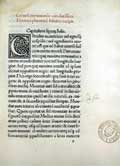
Gerard of Cremona (Italian: Gherardo da Cremona; Latin: Gerardus Cremonensis; c. 1114 - 1187), the Italian translator of Arabic scientific works was most famous as the translator of Ptolemy's Astronomy from Arabic texts found in Toledo. He was one of a small group of scholars who invigorated medieval Europe in the 12th century by transmitting Greek and Arab traditions in astronomy, medicine and other sciences, in the form of translations into Latin, which made them available to every literate person in the West.
Gerard was born in Cremona. Dissatisfied with the meager philosophies of his Italian teachers, Gherardo followed his true passions and went to Toledo. There he learned Arabic at a school for translators, initially so that he could read Ptolemy's Almagest, which retained its traditional high reputation among scholars, even though no Latin translation existed. Although we do not have detailed information of the date when Gerard went to Castile, it was no later than 1144.
Toledo, which had been a provincial capital in the Caliphate of Cordoba and remained a seat of learning, was safely available to a Catholic like Gerard, since it had been conquered from the Moors by Alfonso VI of Castile. Toledo remained a multicultural capital. Its rulers protected the large Jewish colony, and kept their trophy city an important centre of Arab and Hebrew culture, one of the great scholars associated with Toledo being Rabbi Abraham ibn Ezra, Gerard's contemporary. The Moorish and Jewish inhabitants of Toledo adopted the language and many customs of their conquerors, embodying Mozarabic culture. The city was full of libraries and manuscripts, the one place in Europe where a Christian could fully immerse himself in Arabic language and culture. In Toledo Gerard devoted the remainder of his life to making Latin translations from the Arabic scientific literature.
Gerard of Cremona's Latin translation of an Arabic text was the only version of Ptolemy's Almagest that was known in Western Europe for centuries, until George of Trebizond and then Johannes Regiomontanus translated it from the Greek originals in the fifteenth century. The Almagest formed the basis for a mathematical astronomy until it was eclipsed by the theories of Copernicus. Gerard edited for Latin readers the Tables of Toledo, the most accurate compilation of astronomical data ever seen in Europe at the time. The Tables were partly the work of Al-Zarqali, known to the West as Arzachel, a mathematician and astronomer who flourished in Cordoba in the eleventh century.
Al-Farabi, the Islamic "second teacher" after Aristotle, wrote hundreds of treatises. His book on the sciences, Kitab al-lhsa al Ulum, discussed classification and fundamental principles of science in a unique and useful manner. Gerard rendered it as De scientiis (On the Sciences).
Gerard translated Euclid's G
eometry and Alfraganus's Elements of Astronomy.Gerard also composed original treatises on algebra, arithmetic and astrology. In the astrology text, longitudes are reckoned both from Cremona and Toledo.